

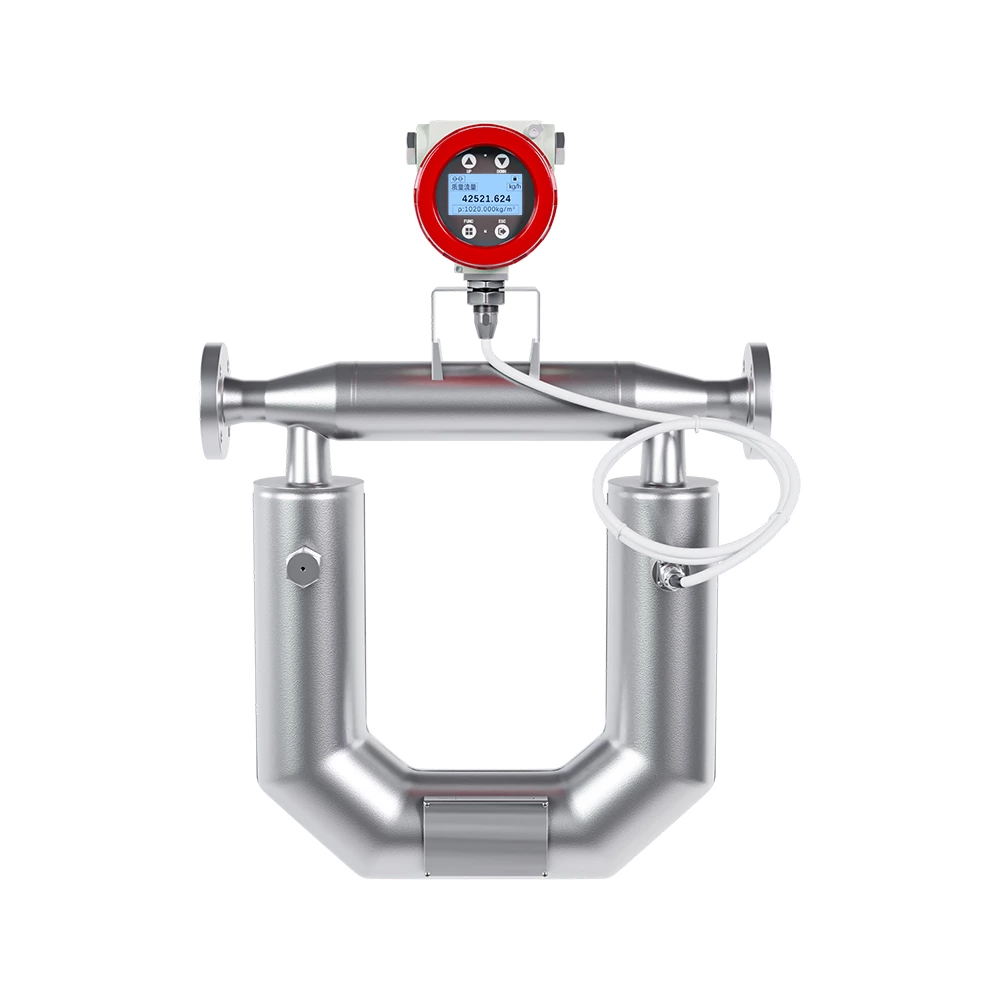
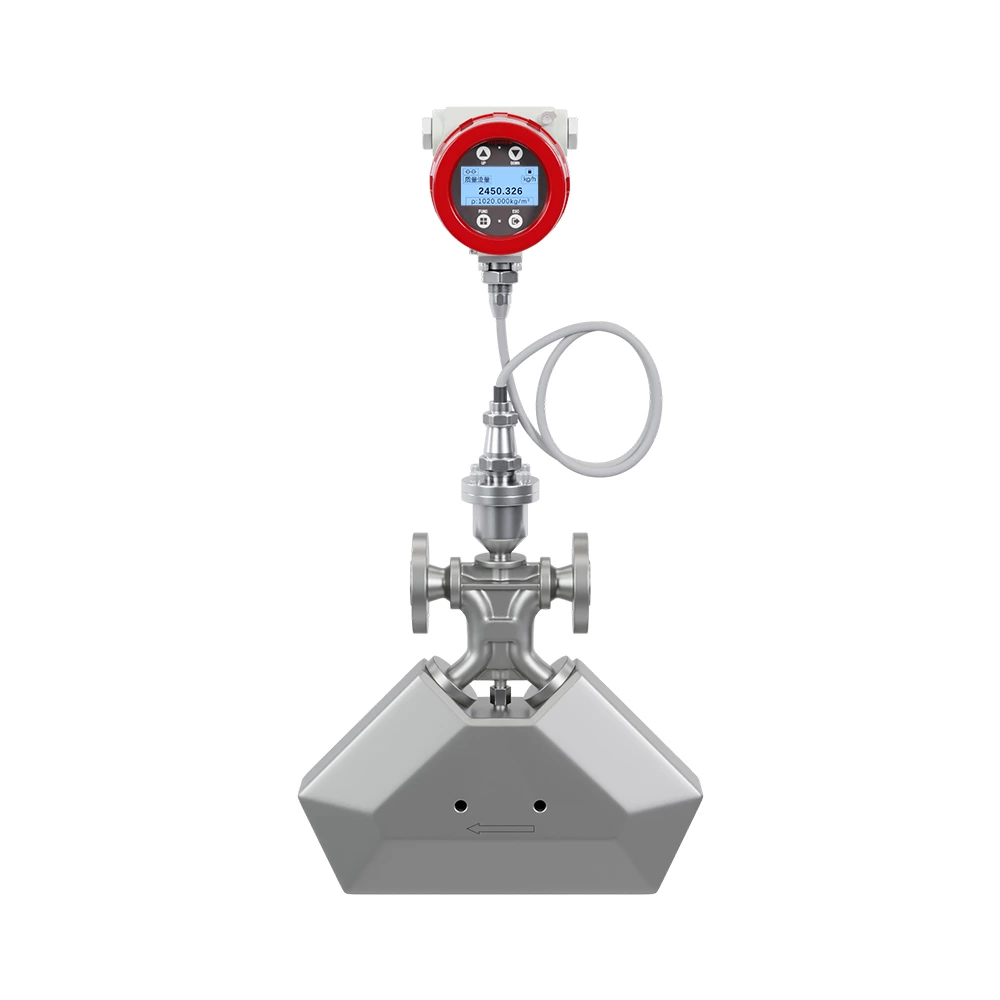
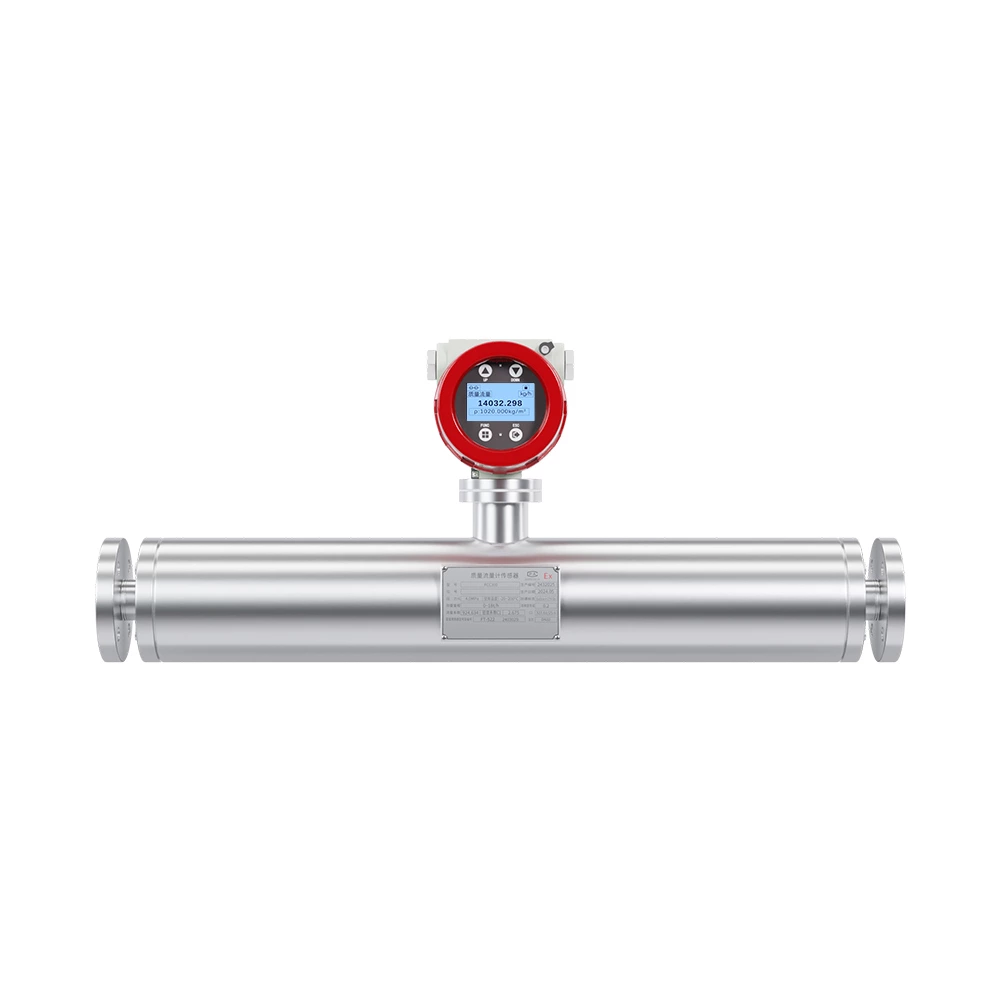
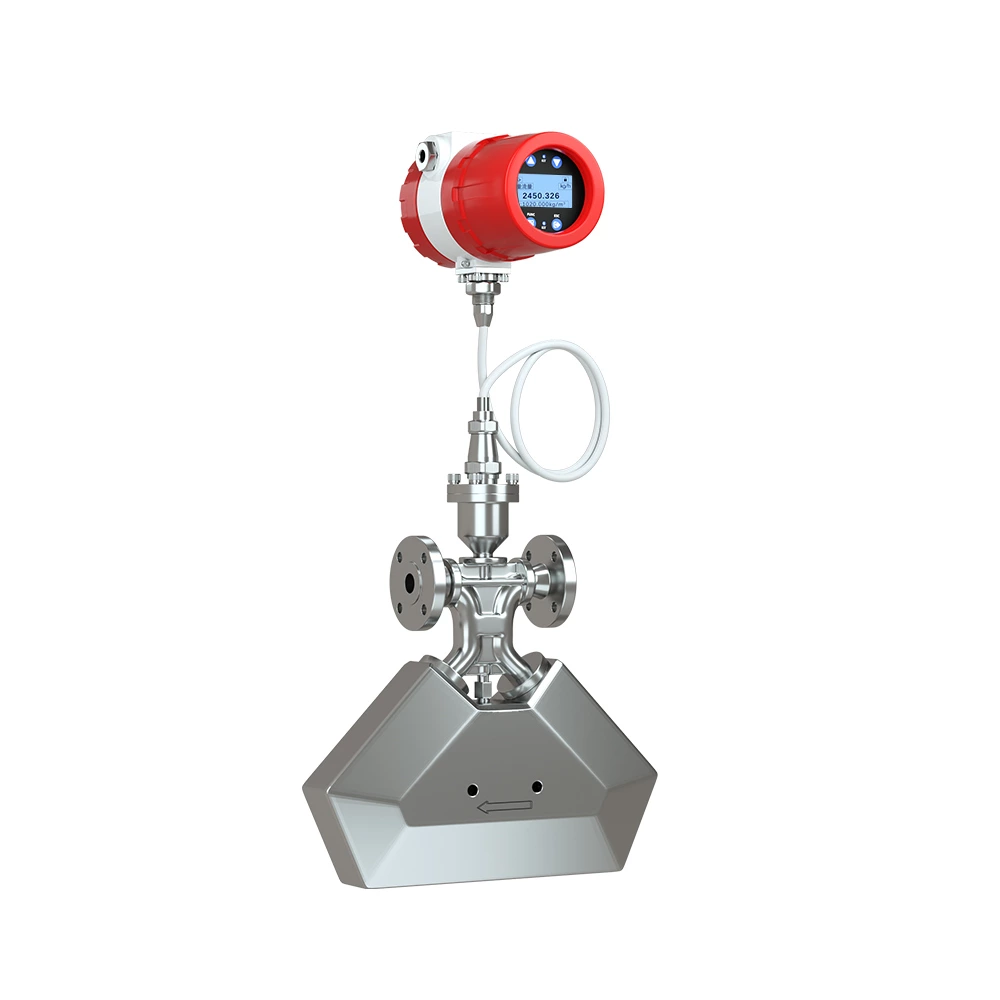
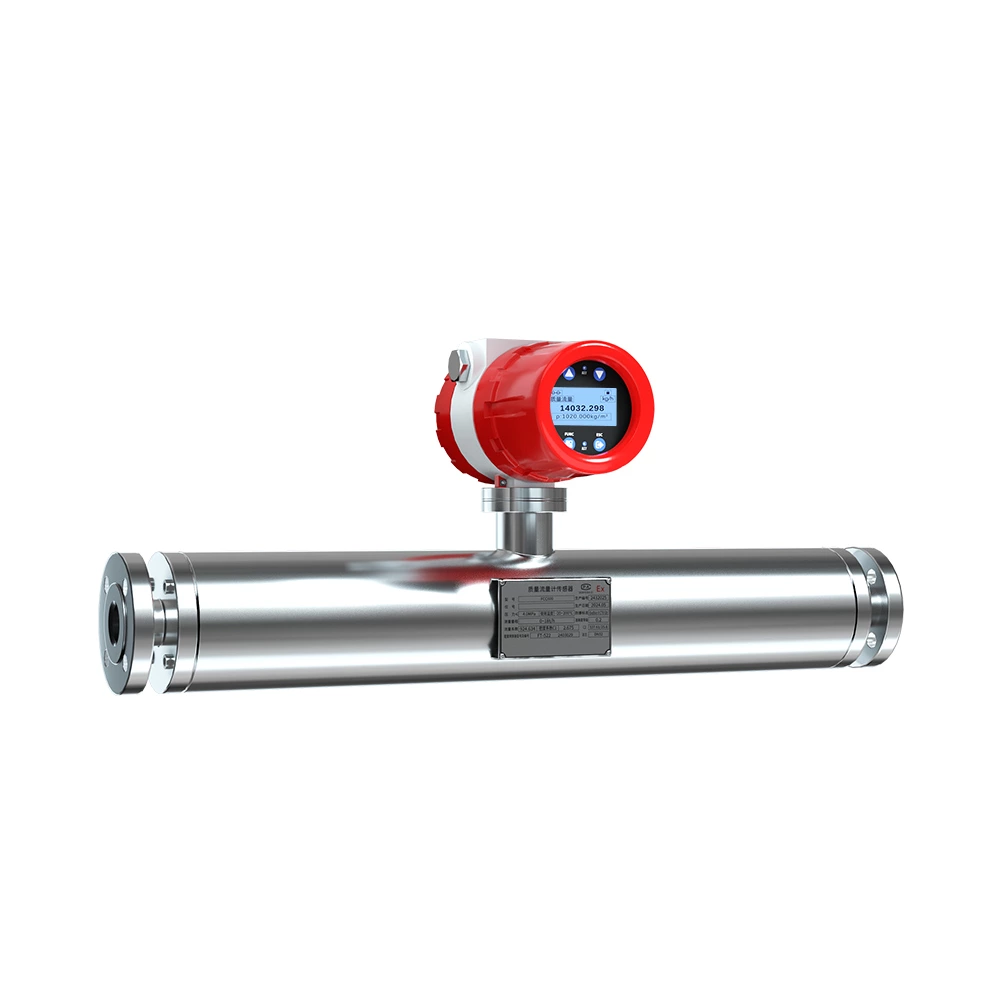
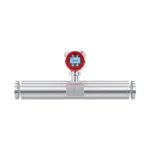
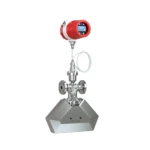
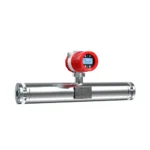
FCC-300 Coriolis Effect Mass Flow Meter For Oil, Gas, Liquid Processing
Coriolis effect mass flow meter is an advanced precision device that measures mass flow rate, density, and temperature of fluids in closed pipelines. Operating on the principle of Coriolis force, it provides accurate measuring solutions and readings for a wide range of industries, including chemical, petroleum, water treatment, food and beverage, pharmaceuticals, paper manufacturing, renewable energy production, and more.
This micro motion Coriolis mass flow meter adheres to the GB/T 31130-2014 standard for mass flow measurement, ensuring reliable and consistent performance across applications.
Characteristics
Ideal for High-Viscosity Fluids: Suitable for slurries and suspensions
Precise Measurements: No need for temperature or pressure compensation
Superb Design: Corrosion-resistant and durable
Wide Applications: Oil, gas, chemical, food and beverage, pharmaceuticals, water treatment, renewable energy production
Easy to Use: Simple operation, easy installation, and low maintenance
Advanced Communication: Supports HART and Modbus protocols
Product Categories
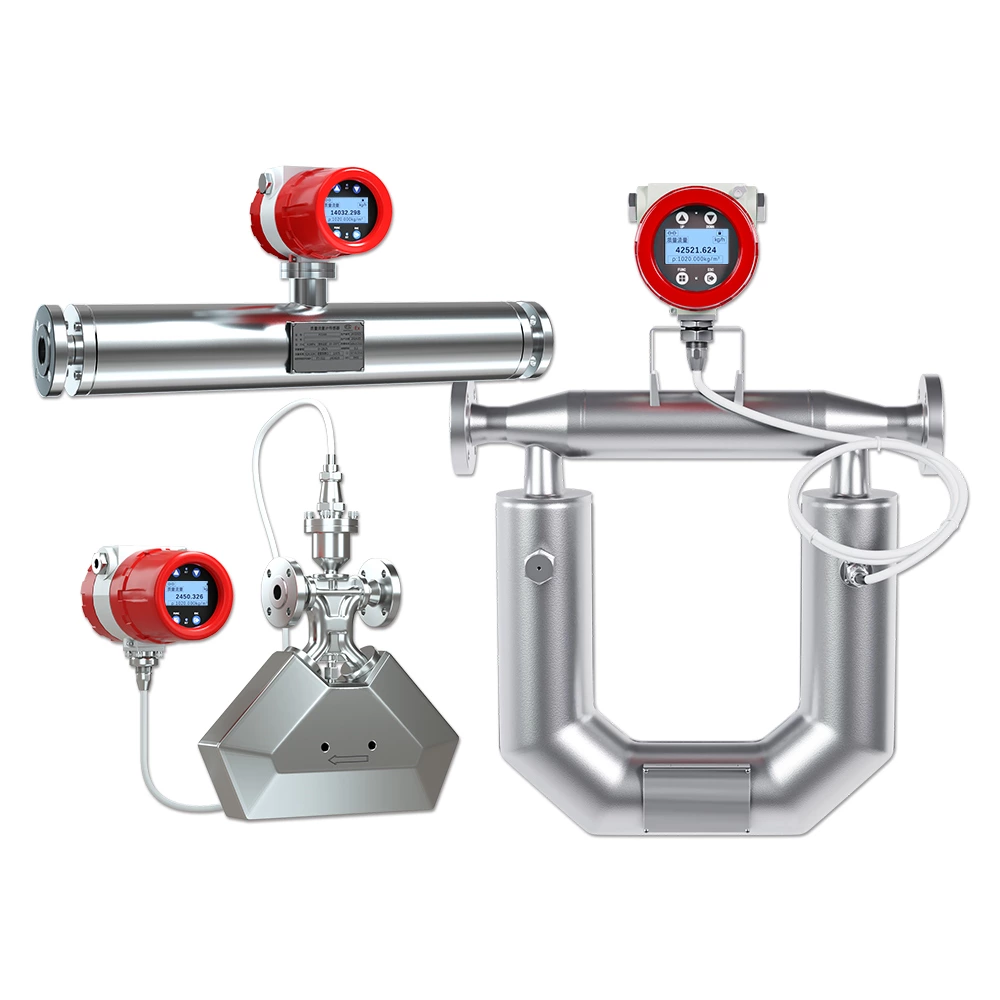
McFlow Coriolis effect mass flow meters provide highly accurate flow measurement for liquids and gases across industries like oil, gas, chemicals, and food production. Based on the advanced Coriolis effect and technology, Supmea Coriolis meters directly measure mass flow, density, and temperature with precision up to ±0.1%.
McFLow flow meter operates on the Coriolis principle that states the circulating air has a deflection to right in the north hemisphere and forward to left in the south globe as the Earth rotates on its axis.
Based on this theory, the Coriolis effect mass flow sensor works in this way: if a pipe is rotated around a point (P) while the fluid is flowing through it (toward or away from the center of rotation), that fluid will generate an inertial force, as shown in Fig.1:
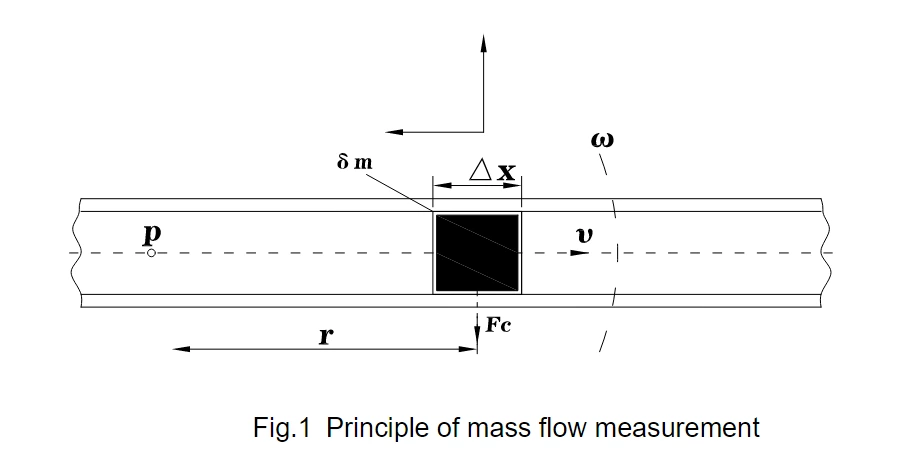
The particle of mass δm moves to the right in the tube at a constant speed υ, while the tube rotates around a fixed point P at an angular velocity ω. At this time, the particle will have two acceleration components:
(1) Normal acceleration αr (Centric acceleration), its value is equal to ω2r, which is directed towards point P.
(2) Tangential acceleration αt (Coriolis acceleration), whose value is equal to 2ωυ, and the direction is αr perpendicular. The force produced by the tangential acceleration is called the Coriolis force, and its magnitude is equal to Fc=2ωυδm.
In the Fig.1 table, the fluid Δm=ρA×ΔX,
So, the Coefficient of friction can be expressed as:
ΔFc=2ωυ×δm=2ω×υ×ρ×A×ΔX=2ω×δqm×ΔX
where A is the cross-sectional area of the tube:
Δqm=δdm/dt=υρA
For a specific rotating tube, its frequency characteristics are certain; ΔFc depends only on δqm. Therefore, the mass flow can be measured directly or indirectly by measuring the Coriolis force.
For more details on how the Coriolis mass flowmeter works, please visit our manual PDF of the SUP Coriolis effect mass flow measurement for custody, oil, gas, water, or wastewater processing.
| Diameter | U-type: DN20~DN150; Triangular: DN3~DN15; Straight Tube: DN8~DN80 |
| Measurand | Mass flow, density, temperature |
| Density accuracy | Earth 0.002g/cm³ |
| Accuracy | 0.1%, 0.15%, 0.2% |
| Temperature | -40℃~+60℃ |
| Power consumption | <15W |
| Power supply | 220VAC; 24VDC |
| Signal output | 4~20mA, RS485, HART |
| Ingress protection | IP67 |
| Density range | 0.3~3.000g/cm³ |
| Repeatability | 1/2 of the measurement error |
| Medium temperature |
Standard type: (-50~200)℃; (-20~200)℃ High temperature type: (-50~350)℃ Low-temperature type: (-200~200)℃ |
| Process pressure | 0~4.0MPa |
| Humidity | 35%~95% |
| Transmission output | (4~20) mA, output load (250~600) Ω |
Q: What is the principle of the Coriolis Effect?
A: The Coriolis effect is a phenomenon that occurs when a fluid flows through a vibrating tube. As the tube vibrates, the fluid’s motion causes a shift in the vibration pattern, which is directly proportional to the mass flow rate. This shift is detected and used to measure the flow, density, and temperature of the fluid. It delivers accurate, reliable flow solutions without requiring temperature and pressure compensation.
Q: What is the difference between the ultrasonic flowmeter and the Coriolis flow meter?
A: The most significant difference between the ultrasonic flowmeter and the Coriolis mass flowmeter lies in the measurement method. Ultrasonic Flowmeters use sound waves to measure the flow rate of liquids or gases, which calculates the flow based on the time it takes for sound waves to travel through the fluid. The Coriolis mass flowmeter measures mass flow directly using the Coriolis effect. It detects changes in vibration caused by the fluid’s movement through a vibrating tube, providing accurate readings of mass flow, density, and temperature.
Q: What’s the difference between the thermal mass flow meter and the Coriolis type mass flow meter?
A: A thermal mass flow meter measures the mass flow rate based on changes in temperature as the fluid passes over a heated sensor, which is ideal for measuring gases and commonly seen in precise gas flow measurement cases. Coriolis Mass Flowmeter uses the Coriolis effect to measure mass flow directly by detecting changes in the vibration of a tube through which the fluid flows. It provides flow, density, and temperature with high accuracy in oil, liquids, and gas processing plants.
Q: How do I select the right Coriolis mass flow meter for my application?
A: Selecting the right Coriolis mass flow meter depends on your process fluid, pipe size, flow range, and installation environment. McFlow offers expert guidance to help you choose the best model for your needs. Just contact our experts to find the right configuration for your application.
Q: Can a Coriolis mass flow meter be used for custody transfer?
A: Yes. McFlow Coriolis mass flow meters are designed to meet international standards for custody transfer, providing highly accurate mass flow and density measurements required for fiscal applications.
Related Products
Characteristics Features 1. Full port, outside...

Diameter range: DN15~DN200 Pressure range :1.6MPa...
Coriolis effect mass flow meter is...
The electromagnetic flowmeter is designed based on the...